


Study on Reduction of Fish Meal Dosage - Case 4. Applied Research on White Fishmeal Reduction Strategy for Chinese Softshell Turtle
【Article Co-published by Mytech, Zhejiang XXX Enterprise and Huzhou Normal University】 2023, Zongsheng Qiu, Qiyou Xu, Aquaculture Nutrition https://doi.org/10.1155/2023/6628805  |
1 Application Background
In commercial production, the fishmeal dosage in Chinese softshell turtle feed formulation has remained high at approximately 50%-60%. The formulations impose high requirements on fishmeal quality, with particularly high reliance on low-histamine white fishmeal (its proportion can reach up to 40%).
Currently, driven by soaring fishmeal price (as of April 8, US white fishmeal stood at CNY 20,500-20,800/t, and Russian white fishmeal at CNY 16,700-17,000/t) and instability in supply channels, the industry faces significant pressure in raw material procurement and feed cost control (pushing feed price up by around CNY 500/t).
Mytech Enzymatic Cottonseed Protein (ECP) boasts high nutritional value (CP ≥60%, protein digestibility >88%, acid-soluble protein >35%) and high functional value (150-1000 Da small-molecule active peptides account for 20% of total mass, total antioxidant capacity in ABTS method is 50% and 7-8% Arginine). It helps with maintain the aqua culture feed quality and improve the aqua culture animal health.
2 Application Solution
Based on a softshell diet with 55% white fishmeal inclusion, this solution used graded levels of ECP to replace fishmeal on an equal-weight basis. It evaluated the effects on the growth, health status and feed cost of softshell turtles, so as to identify the fishmeal reduction scheme with optimal efficacy and optimal cost.
Group | Nutrition Level | Fishmeal | ECP | Evaluation Indicators |
Control group (ECP0) | CP 44% EE 8% (Extruded feed) | 55% | 0% | Growth performance Intestinal growth development, digestibility Intestinal anti- inflammatory capacity Formulation cost: ↓ by CNY 200–600 per tonne (Calculated based on Peruvian super steam fishmeal at CNY 18,600–19,000 per tonne and US white fishmeal at CNY 20,500–20,800 per tonne) |
2% ECP group (ECP2) | 53% | 2% | ||
4% ECP group (ECP4) | 51% | 4% | ||
6% ECP group (ECP6) | 49% | 6% | ||
Groups & period: 4 groups, 4 replicates/group, 30 turtles/replicate, 8-week greenhouse culture | ||||
3 Application Effect
(1) Replacing white fishmeal with 2%–6% ECP can improve the growth performance of Chinese softshell turtles, boost farming yield, advance market launch, and generate higher farming profits. Among all dosages, the 4% inclusion level delivers the optimal efficacy, while the 6% inclusion level achieves the best cost performance.
Control Group | ECP 2 | ECP 4 | ECP 6 | Improvement magnitude | |
Initial body weight g | 3.44 | 3.44 | 3.44 | 3.44 | - |
Final body weight g | 30.88b | 33.76a | 33.84a | 33.15ab | ↑ 7-10% |
Weight gain rate % | 798.02b | 880.25a | 882.92a | 863.69ab | ↑66-85 percentage points |
Specific growth rate %/d | 3.92b | 4.07a | 4.08a | 4.04a | ↑ 3-4% |
FCR | 0.88a | 0.76b | 0.77b | 0.79b | ↓10-14% |
Note: Different superscripts in the same column indicate significant differences among groups (p < 0.05). The same applies hereinafter. | |||||
(2) Replacing White Fishmeal with ECP Promotes Intestinal Development and Health and Enhances Digestive and Absorptive Capacity
① Promoting Intestinal Growth and Development: The 2%–6% ECP groups exhibit better or comparable intestinal development, with the 4% inclusion group delivering the best efficacy. It can significantly boost intestinal developmental health, and support the intestine in carrying out its digestive, absorptive and immune barrier functions.
Control Group | ECP 2 | ECP 4 | ECP 6 | Improvement magnitude | |
Villus height μm | 336.69b | 389.31ab | 422.52a | 408.16a | ↑ 16-25% |
Villus width μm | 107.41c | 136.46a | 130.96ab | 114.46bc | ↑ 7-27% |
Muscular layer thickness μm | 60.95b | 62.95ab | 72.07a | 60.36b | ↑ by 3%–18% or comparable |
Intestinal tissue sections |  |  |  |  | - |
② Improving Digestive and Absorptive Capacity: The 2%–6% ECP groups exhibit elevated intestinal digestive enzyme activities, with the 4% inclusion group demonstrating the strongest digestive capacity.
Pepsin | Lipase |
 |  |
(3) Replacing White Fishmeal with ECP Enhances Immunity and Ensures Organism Health Capacity Under External Stress
① Enhancing Intestinal Anti-Inflammatory Capacity: The 2%–6% ECP inclusion groups increase the expression of intestinal anti-inflammatory cytokines and decrease that of pro-inflammatory cytokines, with the 4% inclusion group significantly boosting intestinal anti-inflammatory capacity.
Anti-inflammatory cytokines IL-10 | Pro-inflammatory cytokines TNF-α、IL-1β、IL-8 | |||
 |  |  |  |  |
② Enhancing Non-Specific Immune Capacity of the Organism: The 2%–6% ECP inclusion groups increase the content of non-specific immune substances in serum, with the 4% inclusion group significantly boosting immunity. When subjected to external environmental stress, the turtles can exert stronger resistance to maintain organismal health.
Total Protein | Globulin |
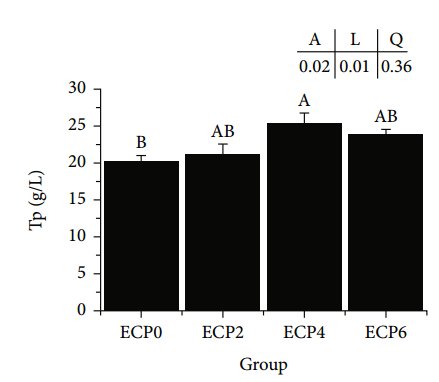 |  |
4 Application Value of ECP
In Chinese softshell turtle feeds with 55% white fishmeal inclusion, replacing white fishmeal with 2%–6% ECP on an equal-weight basis can accelerate growth rate, improve intestinal health and digestive function, and enhance organismal immune capacity. The 4% inclusion level delivers optimal efficacy (formulation cost reduced by approximately CNY 380–400 per tonne), while the 6% inclusion level achieves optimal cost performance (formulation cost reduced by approximately CNY 520–650 per tonne).
【Stay Tuned for the Next Issue】
Study on Reduction of Fish Meal Dosage - Case 4. Applied Research on White Fishmeal Reduction Strategy for Channel Catfish


Comments