


Study on Reduction of Fish Meal Dosage - Case 3. Applied Research on Fishmeal Reduction Strategy in Low-Protein Feed for Yellow Catfish
[Papers jointly published by Mytech and universities]
(https://doi.org/10.1016/j.aninu.2025.03.022)
(https://link.springer.com/article/10.1186/s40104-025-01248-z) |
High-efficiency utilization of aquafeed can reduce excessively high protein content in feed
In production practice, the CP level in yellow catfish feed formulations is approximately 40-46% (the CP level of yellow catfish feed in Sichuan in 2025 was 2-3 pts higher than that in 2024). Which is 2-4 pts above the protein requirement. In production, excessive protein not only increases the cost of yellow catfish feed, but also imposes a burden on the liver and intestines and compromises health. Moreover, undigested and unabsorbed protein excreted into the water body will increase the water quality regulation costs. By improving the protein utilization efficiency of feed, low-protein diets can deliver high-quality performance.
1 Application Solution
This application solution evaluated the influence of low-protein feed to the growth and health of yellow catfish, and invested whether enzymatically hydrolyzed cottonseed protein (EHCP) can improve feed protein utilization efficiency in yellow catfish while secure their growth performance, absorptive and digestive capacity, as well as disease resistance and stress tolerance. The results provide a reference for the application of enzymatically hydrolyzed cottonseed protein in increasing the utilization rate of low-protein feed. The application solution for yellow catfish is as follows:
CP 42% Group: Peruvian super steam fishmeal 25% + Poultry meal 15% + Soybean meal 16.68% + Corn gluten meal 8.5%
CP 39% Group: CP reduced by 3 pts via proportional reduction of all protein ingredients
CP 39% Group + Enzymatically Hydrolyzed Cottonseed Protein Group: On the basis of the low-protein group, replace fishmeal with 1-5% EHCP on equal protein basis
Groups | Fishmeal | EHCP | Evaluating indicators |
CP 42% Group | 25.0% | 0% | Growth Performance Intestinal digestive and absorptive capacity Disease resistance: DDS (dextran sulfate sodium) induce intestinal inflammation |
CP 39% Group | 23.1% | 0% | |
CP 39%+1% Product Group | 22.1% | 1% | |
CP 39%+2% Product Group | 21.1% | 2% | |
CP 39%+3% Product Group | 20.1% | 3% | |
CP 39%+4% Product Group | 19.1% | 4% | |
CP 39%+5% Product Group | 18.1% | 5% |
2 Application Effects
(1) EHCP improved the protein utilization efficiency and growth performance of yellow catfish fed the 39% CP diet, with effects superior to those of the 42% CP diet.
Compared with the CP 42% group, the CP 39% group showed significantly decreased growth performance and body protein deposition rate, along with increased FCR.
Supplementation with 2~3% EHCP in the CP 39% group significantly increased growth performance and body protein deposition, which exceeded those of the CP 42% group.
| CP 42% Group | CP 39% Group | 1% Product Group | 2% Product Group | 3% Product Group | 4% Product Group | 5% Product Group | 2-3% Product Group Compare with the CP 39% Group | 2-3% Product Group Compare with the CP 42% Group |
Weigh Gain Rate % | 388.32 | 342.99c* | 364.46bc | 451.22a | 411.06ab | 347.14c | 333.33c | ↑ 20-32% | ↑ 6-16% |
Specific Growth Rate %/d | 2.26 | 2.13c | 2.19bc | 2.44a | 2.33ab | 2.14c | 2.09c | ↑ 9-15% | ↑ 3-8% |
Feed Intake g/fish | 29.41 | 28.22c* | 28.54c | 32.09a# | 30.38b | 28.23c | 26.91d | ↑ 8-14% | ↑ 3-9% |
FCR | 1.29 | 1.40b ns | 1.33ab | 1.21a | 1.27ab | 1.38ab | 1.37ab | ↓ 9-14% | ↓ 2-6% |
Protein Efficiency | 1.84 | 1.82b | 1.92 | 2.07 | 2.01 | 1.82 | 1.85 | ↑ 10-14% | ↑ 9-13% |
Body Crude Protein Level % | 15.73 | 15.19bc | 16.29ab | 16.56a | 15.73abc | 15.43abc | 15.01c | ↑ 4-9% | ↑ 5% |
Protein Deposition Rete % | 29.25 | 27.84c | 31.97b | 35.15a# | 32.07b | 28.43c | 27.77c | ↑ 15-26% | ↑ 10-20% |
*Indicates a significant difference between the CP 42% group and the CP 39% group (P < 0.05); # Indicates a significant difference between the CP 42% group and the 2% product group (P < 0.05). | |||||||||
(2) EHCP compensated for the deficiencies in intestinal development, digestion and absorption of yellow catfish fed the 39% CP diet, and the performance is superior to that of the 42% CP diet.
① EHCP promoted intestinal growth and development and improved tight-junction structure.
Compared with the CP 42% group, yellow catfish in the CP 39% group exhibited intact intestinal structure yet insufficient intestinal development, together with reduced tight-junction protein expression.
Supplementation with 2~3% EHCP to the CP 39% group significantly improved development and tight-junction protein expression compared with the CP 39% group, and these indices exceeded those of the CP 42% group.
| CP 42% Group | CP 39% Group | 2% Product Group | 3% Product Group | 2-3% Product Group Compare with the CP 39% Group | 2-3% Product Group Compare with the CP 42% Group | |
Intestinal Length Index/ % | 55.39 | 52.86c | 62.92a# | 57.61b | ↑9-19% | ↑4-14% | |
Stomatic Intestinal Index/ % | 1.22 | 1.14b | 1.34a# | 1.30a | ↑14-18% | ↑7-10% | |
Fold Height/μm | 412.25 | 337.62bc | 460.99a | 392.19b | ↑16-37% | ↑0-12% | |
Fold Width/μm | 126.50 | 116.09ab | 139.44a | 134.95a | ↑16-20% | ↑7-10% | |
Muscle Layer Thickness/μm | 46.43 | 39.13b | 48.55a | 48.98a | ↑24-25% | ↑4-5% | |
Goblet Cell Count Improves intestinal health and promotes digestion and absorption | 42.00 | 34.33b* | 52.00a# | 58.00a | ↑51-69% | ↑24-38% | |
Mid-gut Tissue Sections | Intestinal Tight-junction Gene Expression | ||||||
 |  |  |  |  | |||
*Indicates a significant difference between the CP 42% group and the CP 39% group (P < 0.05); # Indicates a significant difference between the CP 42% group and the 2% product group (P < 0.05); see the original literature for details. | |||||||
② EHCP improved the digestibility of protein and lipid for intestines.
Compared with the CP 42% group, the CP 39% group exhibited a marked decrease in intestinal digestive enzyme activities and apparent crude protein digestibility.
Supplementation with 2~3% EHCP to the CP 39% group markedly increased protease and lipase activities, which markedly increased apparent crude protein digestibility, with both indices exceeding those of the CP 42% group.
| CP 42% Group | CP 39% Group | 2% Product Group | 3% Product Group | 2-3% Product Group Compare with the CP 39% Group | 2-3% Product Group Compare with the CP 42% Group | |
Pepsin U/mg prot | 11.88 | 10.00c* | 12.03a# | 11.27b | ↑13-20% | 1% | |
Chymotrypsin U/mg prot | 2.23 | 1.54e* | 6.14a# | 5.56b | ↑261-299% | ↑149-175% | |
Trypsin U/mg prot | 6373.76 | 5850.16b | 6263.65b | 5975.03b | ↑2-7% | - | |
Aminopeptidase U/mg prot | Exoprotease | 1.03 | 1.03d | 5.83a# | 5.79a | ↑462-466% | ↑462-466% |
Carboxypeptidase U/mg prot | 35.23 | 28.94e* | 136.67a# | 130.70a | ↑352-372% | ↑271-288% | |
Pancreatic U/mg prot | 0.74 | 0.47d* | 0.70a | 0.57b | ↑21-49% | - | |
Lipase U/mg prot | 133.71 | 114.25c* | 163.70a# | 144.51b | ↑26-43% | ↑8-22% | |
Apparent crude protein digestibility% | 73.75b | 69.89b | 81.46a | - | ↑17% | ↑10% | |
*Indicates a significant difference between the CP 42% group and the CP 39% group (P < 0.05); # Indicates a significant difference between the CP 42% group and the 2% product group (P < 0.05); see the original literature for details. | |||||||
③ EHCP enhanced the intestinal absorptive capacity for nutrients (amino acids and small peptides).
Following digestion and breakdown in the fish intestine, protein is mainly absorbed in the form of free amino acids, dipeptides and tripeptides.
Compared with the CP 42% group, the CP 39% group showed marked decrease in intestinal levels of brush border enzymes, amino acid transporters and peptide transporters that facilitate absorption.
Supplementation with 2~3% EHCP in the CP 39% group increased the transport and absorption of amino acids and proteins, with these indices exceeding those of the CP 42% group.
| CP 42% Group | CP 39% Group | 2% Product Group | 3% Product Group | 2-3% Product Group Compare with the CP 39% Group | 2-3% Product Group Compare with the CP 42% Group | |
Brush border enzymes Facilitate absorption | γ-glutamyl transferase | 24.97 | 14.00d* | 22.64b | 25.12a | ↑62-79% | ↑0.6% |
Na⁺/K⁺-ATPase | 150.46 | 85.40e* | 188.66a# | 128.40b | ↑50-121% | ↑25% | |
mRNA expression levels of amino acid transporters | Protein expression level of the peptide transporter PepT1 | ||||||
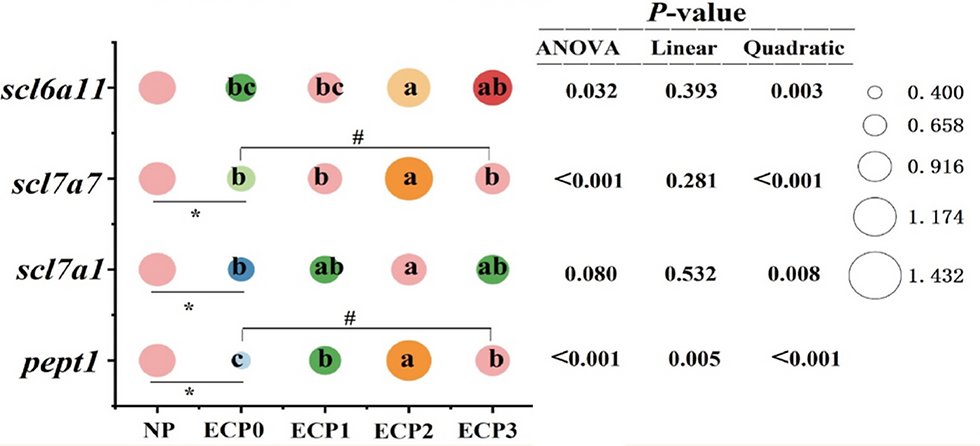 |  | ||||||
*Indicates a significant difference between the CP 42% group and the CP 39% group (P < 0.05); # Indicates a significant difference between the CP 42% group and the 2% product group (P < 0.05); see the original literature for details. | |||||||
(3) EHCP ameliorated the insufficiency of intestinal resistance caused by the 39% CP diet in yellow catfish, with the indices exceeding those in the CP 42% group.
An intestinal inflammation model was established in yellow catfish via rectal administration of DSS, with the PBS-perfused group with normal intestinal healthy intestinal serving as the reference control.
① EHCP reduced the enteritis incidence, ensured the intestinal structural integrity, and increased the survival rate.
Compared with the CP 42% group, the CP 39% group showed a marked damage to intestinal cells, as well as elevated enteritis incidence and mortality.
Supplementation with 2% EHCP in the 39% CP diet reduced damage to the intestinal mucosa, preserved the integrity of the intestinal epithelial cells, and decreased enteritis incidence, the relevant indices exceeded those in the CP 42% group and reached the healthy level of the PBS-perfused group.
Enteritis incidence and mortality | HE-stained intestinal sections | Transmission electron microscopy (TEM) sections of the intestine |
 |  |  |
Staining annotations: circles indicate vacuolar degeneration, triangles indicate congestion, and asterisks indicate inflammatory infiltration. Electron microscopy annotations: red arrows indicate endoplasmic reticulum dilation, red asterisks indicate marked cellular vacuolization, and green asterisks indicate intracellular vacuolization, membrane damage, and myelin-like lesions. | ||
② EHCP enhanced intestinal immunity and anti-inflammatory capacity.
Immunity was enhanced by increasing the synthesis of nonspecific immune factors.
Compared with the 42% CP group, the 39% CP group showed an 18–24% reduction in the content of nonspecific immune factors.
Supplementation with 1–5% EHCP in the 39% CP diet increased the content of nonspecific immune factors by 14–105%, with values exceeding those in the 42% CP group and reaching the level of the PBS-perfused normal group.
| PBS Group | CP 42% Group | CP 39% Group | Compared with CP 42% Group | Supply with 2.0% EHCP | Compared with CP 39% Group | Compared with CP 42% Group |
Lysozyme (LZM) (antibacterial, anti-inflammatory, antiviral) | 81.31±8.48t | 126.23±11.58 | 103.89±9.86b;* | ↓18% | 213.40±20.52d;# | ↑105% | ↑69% |
Complement 3 (C3) (inflammation and immunity) | 33.42±2.07ns | 34.16±0.56 | 24.42±1.37a;* | ↓29% | 31.18±1.28c;# | ↑28% | ↓9% |
Complement 4 (C4) (inflammation and immunity) | 2.55±0.30ns | 2.49±0.28 | 1.88±0.18a;* | ↓24% | 2.95±0.27b;# | ↑57% | ↑18% |
Acid Phosphatase (ACP) (immunity) | 148.51±14.57t | 121.39±11.94 | 126.23±8.60ab;ns | Comparable | 143.40±10.65c;ns | ↑14% | ↑18% |
Immunity is improved by enhancing anti-inflammatory capacity through the regulation of macrophage polarization.
Compared with the 42% CP group, the 39% CP group exhibited increased M1 macrophage polarization and inhibited M2 macrophage polarization, accompanied by aggravated intestinal inflammation.
Supplementation with 2–3% EHCP in the 39% CP diet may promote M2 macrophage polarization and suppress M1 macrophage polarization via activation of the JAK-STAT signaling pathway, thus enhancing intestinal anti-inflammatory capacity and repairing intestinal damage, with effects even superior to those of the 42% CP group.
M1 macrophage (pro-inflammatory) | M2 macrophage (anti-inflammatory/repair) |
 |  |
JAK-STAT signaling pathway | |
 | |
Immunity is enhanced by reducing necroptosis through inhibition of the RIP/MKLK-NLRP3 pathway.
Compared with the 42% CP group, the 39% CP group exhibited comparable or higher levels of necroptosis.
Supplementation with 1–4% EHCP in the 39% CP diet decreased the expression levels of mRNA and proteins related to intestinal cellular necroptosis, and attenuated dextran sulfate sodium (DSS)-induced necroptosis. The 2% dosage showed the optimal effect, which was superior to that of the 42% CP group.
EHCP may exert an anti-necroptotic effect by inhibiting the NF-κB and MAPK signaling pathways, and may also exert its function by suppressing p38 MAPK-AP-1; this remains to be further studied.
Necroptosis-related Genes |  | |
 | ||
(4) EHCP enhanced the resistance of yellow catfish to high ammonia-nitrogen stress in water and increased the survival rate.
Compared with the 42% CP group, the 39% CP group exhibited a higher survival rate under high ammonia-nitrogen stress, indicating that reducing dietary protein levels may mitigate the impact of ammonia-nitrogen stress by alleviating the metabolic burden of the fish body.
Supplementation with 2% EHCP in the 39% CP diet increased the survival rate of yellow catfish under high ammonia-nitrogen stress, with the rate exceeding that of the 42% CP group.
400 min of ammonia-N stress | 520 min of ammonia-N stress | ||||
Control group: 2 fish died | Low-protein group: 0 fish died | Low-protein + product group: 0 fish died | Control group: 8 fish died | Low-protein group: 5 fish died | Low-protein + product group: 4 fish died |
 | |||||
Control group: 5 fish died | Low-protein group: 2 fish died | Low-protein + product group: 1 fish died | Control group: 11 fish died | Low-protein group: 9 fish died | Low-protein + product group: 7 fish died |
440 min of ammonia-N stress | 550 min of ammonia-N stress | ||||
The above results indicate that for yellow catfish, reducing dietary protein from 42% to 39% (a 3-percentage-point reduction) and isonitrogenously replacing Peruvian super steam fishmeal with 2–3% EHCP can improve growth performance and health status, enhance intestinal development, digestion and absorption, as well as anti-inflammatory and stress resistance capacities. The overall efficacy outperforms that of the 42% CP diet, with feed cost lowered by 400–450 yuan per ton.


Comments